Gel lamps, UV light and the skin on your hands
Every gel set ends under a curing lamp, and every curing lamp gives off UV. Dermatologists ask for a little protection first, and it takes less time than the base coat.
What a flash cure lamp is
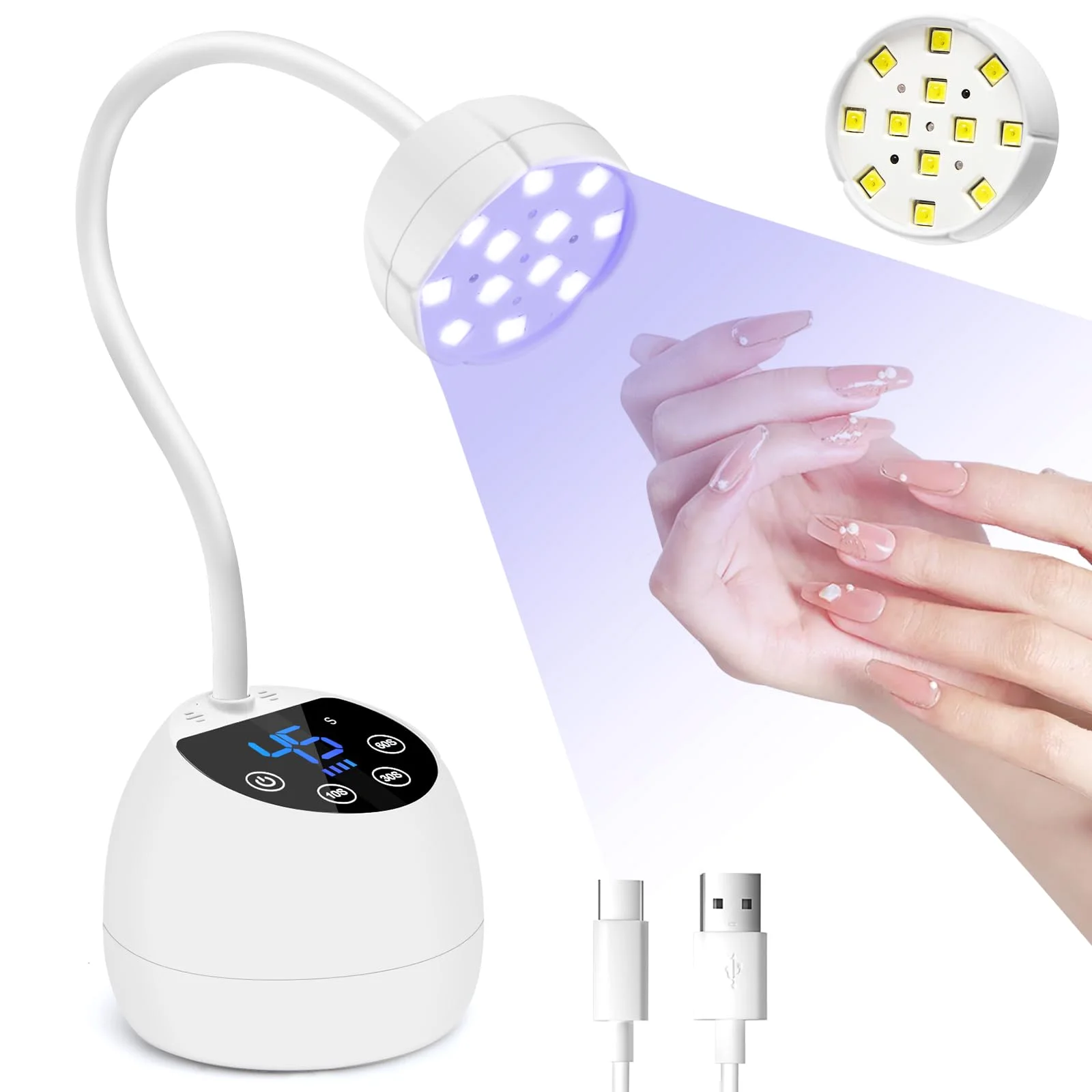
A full-size curing lamp is a tunnel: the whole hand goes in, five fingers at once. A flash cure lamp works the other way around. It is a small head on a bendable neck that you aim at one or two nails, so a tip can be set in place before you move on to the next finger. Our mini cordless UV/LED lamp is that kind of tool, 36 watts through 12 beads in a body of 3.5 x 3.15 x 10.63 inches that weighs 8.3 ounces.
The neck bends through 360 degrees, so the head can come in over a thumb held sideways or a pinky curled under. Four modes sit on the button: 10, 30 and 60 seconds, plus a 45-second auto mode the lamp falls back to. A sensor turns the beads on as a finger comes near and switches them off once it moves more than about 5 centimeters away. The screen shows the countdown and how much battery is left. On a full charge the battery runs up to 2 hours, long enough to work a full set without a cord across the desk.
Gel polish and extension gel both cure under it. Pick the mode the gel maker gives on the bottle, not the one that feels fastest, and count the full time on every nail. A cure that stops short leaves soft product under a hard top, and that is the set that lifts first.
UV lamp or LED lamp, the skin gets UV
Packaging on gel lamps uses two words, UV and LED, and people take the second word to mean no UV at all. The Skin Cancer Foundation says plainly that lamps sold as UV and lamps sold as LED both give off UV radiation, mostly UVA. UVA is the part of sunlight tied to skin aging and to skin cancer. Our lamp makes no secret of it either. Its beads run at 365 nanometers, inside the UVA band, and at 405 nanometers, which is violet light just past it.
How large is the risk? The foundation rates even the strongest of these devices as a moderate UV risk, far lower than a tanning bed. Dermatologists at the American Academy of Dermatology still count it, because a gel client does not sit under a lamp once. Repeat sessions, set after set over the years, are what dermatologists point to when they say gel manicures raise the risk of skin cancer and of premature aging on the hands. They add that the habit can leave nails brittle, peeling and cracked.
None of that means a client has to give gel up. It means the lamp gets the same respect as a sunny afternoon, with the same simple fix.
What dermatologists advise before the lamp
Both organizations land on the same routine, and it fits into the minute between prep and base coat.
- Put a broad-spectrum, water-resistant sunscreen of SPF 30 or higher on the backs of the hands and the fingers. That is the American Academy of Dermatology's wording, and broad-spectrum means it covers UVA as well as UVB.
- Do it about 20 minutes ahead of the first cure. The Skin Cancer Foundation gives that timing, so the sunscreen goes on at the start of the appointment, not at the lamp.
- Suggest the other option the academy names: dark, opaque gloves with the fingertips cut off. The nail stays bare for the gel, and the rest of the hand stays covered.
- Keep a pair of those gloves at the station. A client who forgot hers will not have to choose between her set and her skin.
One limit is worth saying out loud. The Skin Cancer Foundation notes that sunscreen on the hands does not protect against squamous cell carcinoma under the nail, the part the gel covers. Sunscreen and gloves cut the dose to the skin around the nail, and that is all they claim to do.
Regular gel clients are the ones to talk to first. Ask whether they want the gloves or the sunscreen, keep both within reach, and make it part of the set instead of a lecture.
Working with the mini lamp at the station
Placement decides how well a flash lamp works. Stand it on the client's side of the hand pillow, with the neck bent so the head hangs just above the fingertips, and the beads reach the nail from straight overhead instead of at a slant. A slanted head lights one sidewall and leaves the other one dim, and the gel cures unevenly along that edge.
The sensor rewards a steady hand. Because the beads switch off once a finger moves more than about 5 centimeters away, a client who pulls back mid-count stops the cure without either of you noticing. Ask her to rest the finger on the pillow and leave it there until the screen reaches zero. Thumbs usually go on their own, since they sit at a different angle from the other four.
Charge it between clients rather than during one. Two hours of battery covers a full set with time to spare, and a lamp that dies on the ninth nail is a lamp you will start keeping on a cord.
A curing lamp is not a desk light
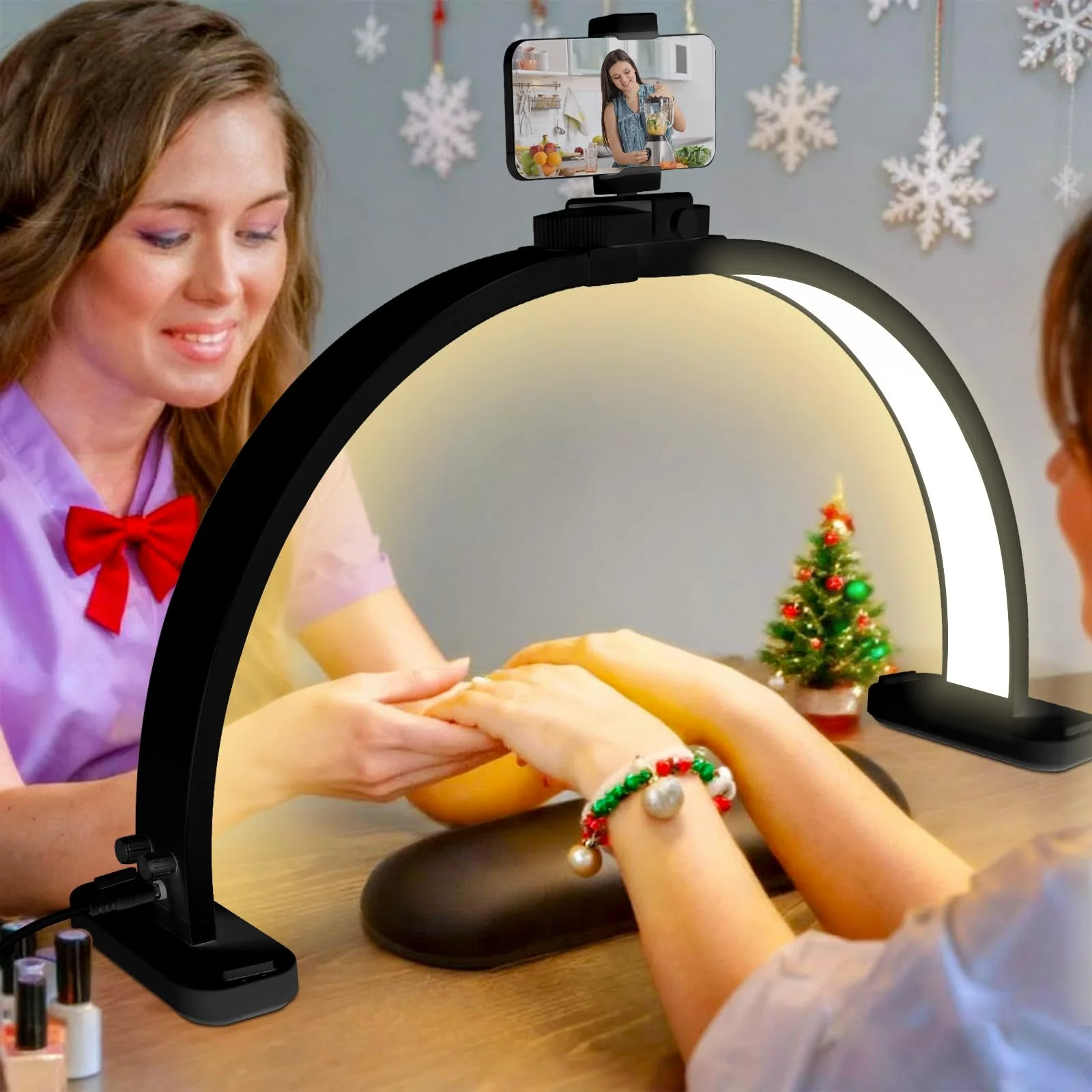
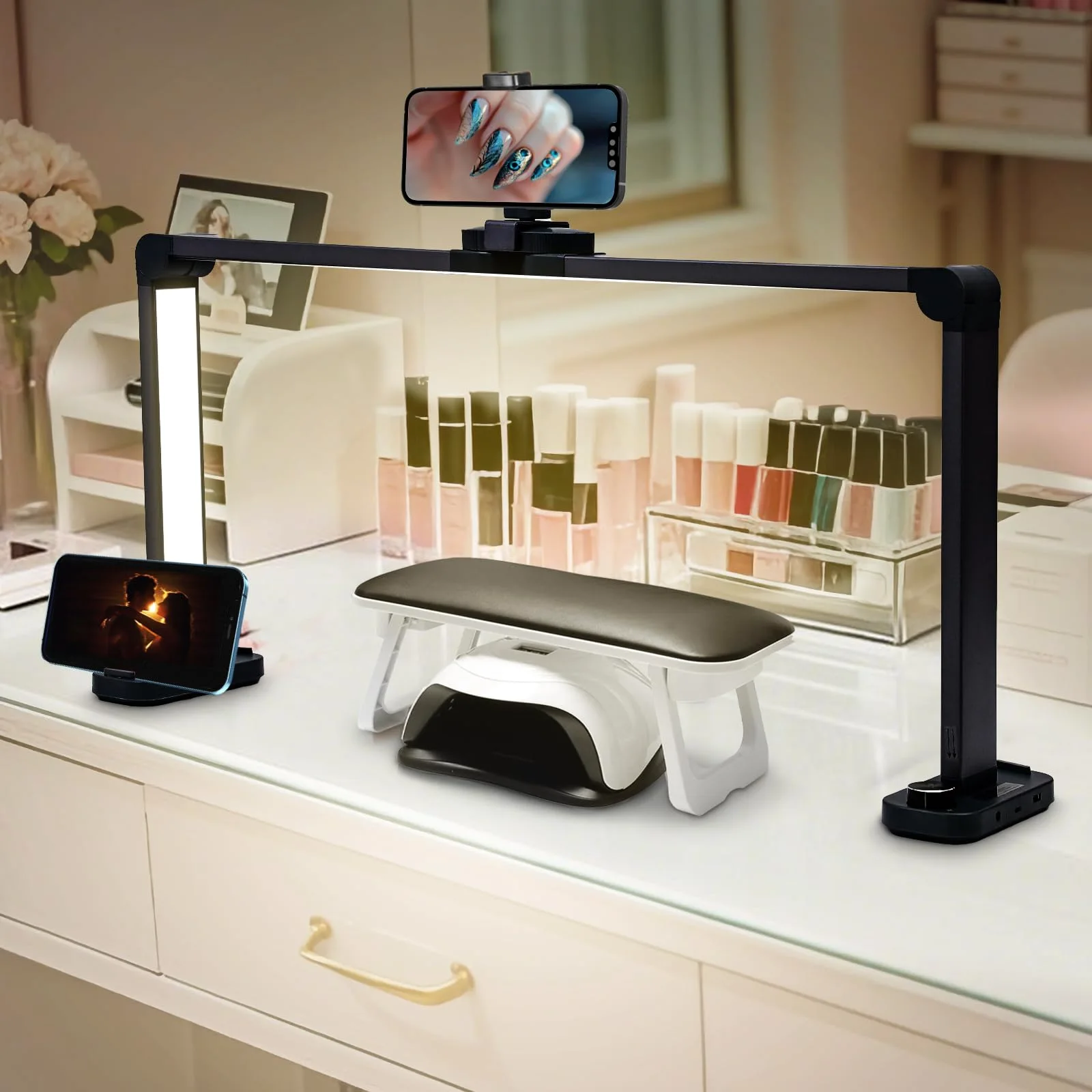
The two lamps on a gel desk often get mixed up, and they should not be. A curing lamp hardens product. Seeing what you are doing is the job of a desk light. Our 30.7-inch half moon light is sold as a lighting lamp, not a UV curing lamp: its 392 LEDs give visible light from warm 3000K to cool 6500K, with a color rendering index of 85 or higher, so shades read true. It will not cure gel, and it is not meant to.
The arch is tall enough, about 14 inches inside, for the mini lamp to stand underneath it. That arrangement works well. The desk light stays on for the whole set, and the curing lamp comes on only for its 10 to 60 seconds per nail.
| Mini cordless UV/LED lamp | Half moon light 30.7 in | |
|---|---|---|
| Job | Cures gel, a nail or two at a time | Lights the hand so you can see the work |
| Light source | 12 beads, 365 nm and 405 nm | 392 LEDs, CRI 85 or higher |
| Settings | 36W, modes of 10 s, 30 s, 60 s and 45 s auto | 10 brightness levels, 3000K to 6500K in 3 settings |
| Size | 3.5 x 3.15 x 10.63 in, 8.3 oz | Arch 30.7 in wide, about 14 in clear inside |
| Before you use it | SPF 30+ or fingerless dark gloves on the client's hands | Set the color temperature for the task |
The rest of a healthy gel routine
Sun protection is one part of what the American Academy of Dermatology asks clients to watch for at a nail appointment. The same page tells them to check that tools are cleaned and disinfected after every client, and not to let anyone push back or cut the cuticle, because that can lead to inflammation and infection. A tech who already works that way earns trust without a speech.
What that cleaning looks like in practice, and why a UV cabinet is storage rather than a disinfecting step, is the subject of our story on cleaning nail tools and the UV cabinet. For the light you work under, see how to light a nail desk.
The mini lamp and the half moon arch sit together on the lamps shelf of everyone at CGBE.